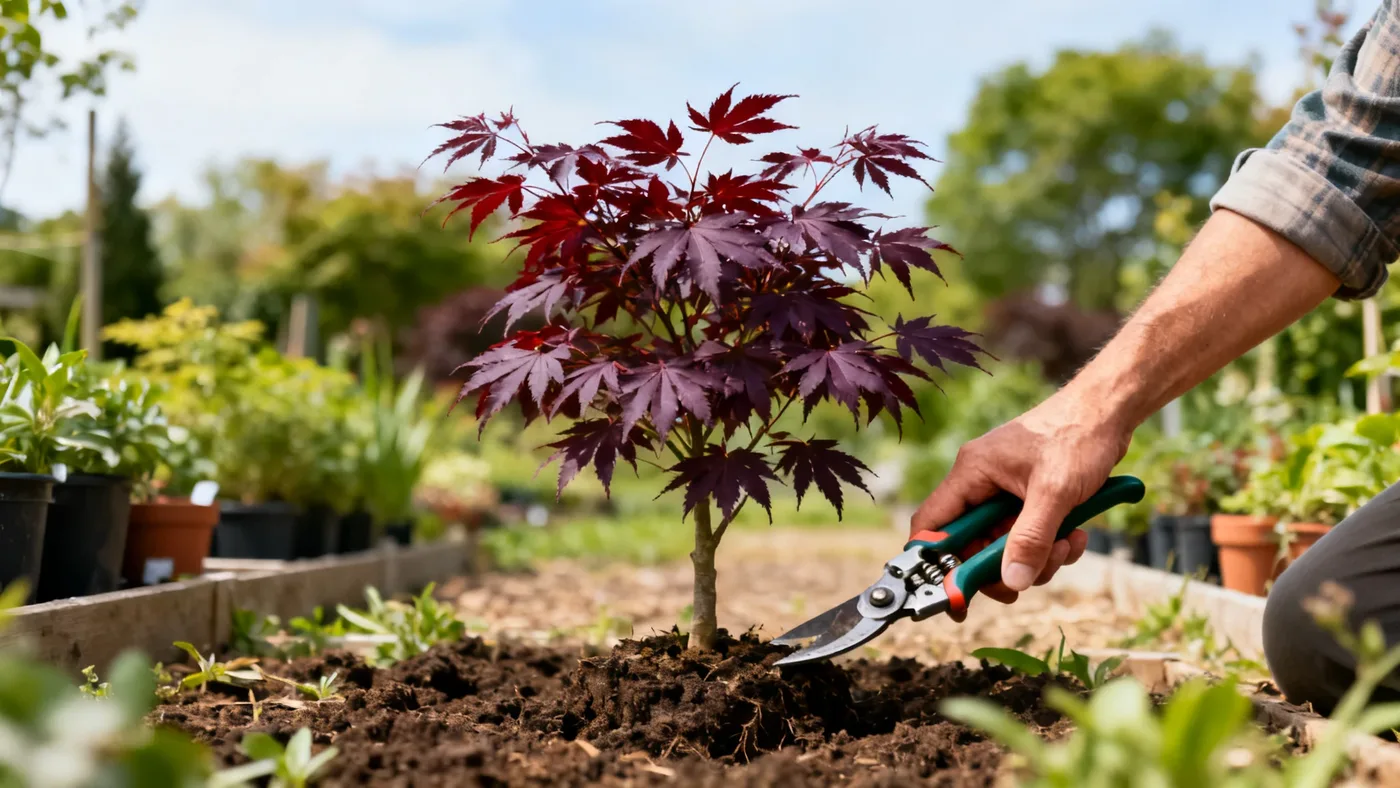
When and How to Prune a Bloodgood Japanese Maple Tree
Bloodgood Japanese Maples are beautiful specimen trees that require surprisingly little maintenance. The good news: you don't need to prune them often. The better news: when you do, the process is straightforward if you know the right timing and technique. Unlike fast-growing ornamentals that demand frequent shaping, your Bloodgood maple grows slowly and naturally, at about 12 to 18 inches per year, developing an elegant form with minimal intervention.
This guide walks you through when to pick up your pruning tools, how to use them properly, and what mistakes to sidestep. Whether you're cleaning up winter damage or gently shaping the canopy, the key is understanding that timing and restraint matter far more than aggressive cutting.
Why Prune Bloodgood Japanese Maples
Pruning serves three main purposes on a Bloodgood maple. First, it removes dead, diseased, or crossing branches that could become structural problems as the tree matures. Second, light shaping can direct growth if you want a particular silhouette for your garden design. Third, opening the canopy slightly improves air circulation, which reduces disease pressure in humid climates.
Here's what you probably don't need to prune for: routine size control. Your Bloodgood will reach 15 to 20 feet tall and wide at maturity, taking 15 to 20 years or more. If that's not the footprint you want, the time to plan is at planting, not after. Drastic size pruning contradicts the tree's nature and weakens it.
When to Prune: The Critical Timing
Timing is everything with Bloodgood Japanese Maple pruning. The best window is late fall to mid-winter, when the tree is fully dormant. This is the season to do your main pruning work: removing deadwood, thinning crowded branches, and shaping.
Why this timing? Japanese maples have a tendency to bleed sap heavily in spring and early summer. If you prune when the tree is actively growing or waking from dormancy, cut wounds will weep copiously. While this is not usually fatal, it stresses the tree and looks messy. Dormant-season pruning minimizes sap bleed and allows the tree to compartmentalize wounds before growth resumes in spring.
Avoid heavy pruning in spring entirely. Light deadwood removal is fine year-round, but save structural cuts for late fall through early winter. If you spot a broken branch in summer, remove it for safety, but hold off on other cuts.
Materials You'll Need
You don't need a large arsenal. A few quality tools make the work cleaner and safer:
- Sharp bypass pruners: For branches up to about three-quarters of an inch diameter. Dull blades crush stems and leave wounds that take longer to heal.
- Pruning saw: A folding pruning saw or bow saw for branches thicker than three-quarters of an inch. Avoid chainsaws if possible, as the vibration and rapid removal can shock the tree.
- Loppers: Long-handled pruners for reaching interior branches and making two-handed cuts with more leverage.
- Pruning sealer (optional): Modern research suggests that large pruning wounds heal better without wound dressing, as the tree's own compartmentalization is more effective. If you choose to use a sealer, apply it only to cuts larger than 1 inch in diameter, and use a thin coat.
- Disinfectant (optional): A 10 percent bleach solution (1 part bleach to 9 parts water) or rubbing alcohol, for wiping tools between cuts if removing diseased branches. This prevents spreading problems from one branch to another.
- Pruning gloves and eye protection: Protect your hands and eyes from sharp branches.
Step-by-Step Pruning Guide
Step 1: Assess the tree. Before cutting anything, walk around your Bloodgood maple and study its overall shape. Look for dead branches (they're brittle and gray), crossing branches that rub together, and any limbs growing inward or downward awkwardly. Make a mental map of what comes out.
Step 2: Remove all dead wood first. Start at the top and work down. Dead branches snap easily and are usually obvious. Make clean cuts just outside the branch collar (the slight swollen ring where the branch meets the trunk or parent branch). Never leave a stub; flush cuts heal faster. If a branch is entirely dead, trace it back to the nearest living branch or trunk.
Step 3: Remove crossing and rubbing branches. If two branches cross and touch, one will eventually damage the bark of the other. Keep the branch with the stronger upright angle, or the one that grows in a more desirable direction. Remove the weaker or less valuable one, again cutting just outside the branch collar.
Step 4: Thin the interior canopy lightly. If the center looks dense, selectively remove one or two interior branches to improve air flow. This is subtle work. Remove maybe 5 to 10 percent of the branching total; if the tree looks noticeably thinner afterward, you've cut too much. The goal is to let light penetrate to the lower foliage without opening gaps.
Step 5: Step back and observe. After each significant cut, stand back and look at the overall silhouette. Japanese maple pruning is not a race. It's fine to remove half your planned cuts, let the tree sit for a week, and finish later. This prevents the common mistake of overcutting in one session.
Step 6: Make clean cuts. Whether using pruners or a saw, cut decisively in one or two motions. Jagged, crushed, or torn bark takes longer to heal. Position your cutting tool so you remove just above the branch collar, leaving a small ring of bark. Never cut flush to the trunk (this removes the collar itself), and never leave a stub.
Tips for Successful Pruning
Work with the tree's form, not against it. Bloodgood Japanese Maples naturally develop a somewhat upright-spreading shape. Resist the urge to turn your tree into a tight ball or sculptural form. Light shaping works; heavy shaping fights the tree's nature.
Don't fertilize after late-winter pruning. Once you've finished your dormant-season cuts, wait until early spring to apply any balanced, slow-release fertilizer. Fertilizing right after pruning can stimulate weak, leggy regrowth.
Prune on a mild, dry day. Wet conditions and freezing nights after pruning can slow wound healing. Late fall or early winter pruning followed by dry days is ideal.
Use the one-third rule carefully. The guideline "never remove more than one-third of a tree's foliage in one year" is sound, but with Bloodgood, err on the side of less. Removing even 15 to 20 percent is usually sufficient.
Common Pruning Mistakes to Avoid
Pruning in spring or early summer. This is the number-one mistake. Excessive sap bleed stresses the tree and wastes the plant's energy. Wait for late fall.
Heavy-handed pruning. One session of aggressive cutting can set back a slow-growing tree by years. Your Bloodgood grows only 12 to 18 inches per year; if you remove a large primary branch, it may take a decade to restore the tree's shape.
Leaving stubs. Stubs don't heal. They invite pests and disease. Always cut back to the branch collar, even if it means using a saw instead of pruners.
Topping the tree. Never cut the main leader or large primary branches to a fixed height to control size. This creates an ugly branching pattern and encourages weak, overcrowded regrowth. If your tree is too large, accept that reality or remove it; don't top it.
Pruning without a plan. Random cutting leaves a tree looking hacked. Spend 5 to 10 minutes assessing before you make the first cut. A mental or written plan prevents regret.
Sealing all cuts. Modern arboricultural research shows that trees compartmentalize wounds naturally and more effectively without wound dressing. Save sealers for very large cuts in diseased areas, and even then, use sparingly.
Expected Results
After proper pruning during the dormant season, you should see these outcomes:
The tree will experience minimal sap bleed and stress, recovering quickly in spring. New growth in the pruned areas may appear slightly lighter in color initially, but the deep burgundy summer color typical of Bloodgood cultivars should return as new foliage matures. The canopy should look more open and naturally balanced, without obvious gaps.
Healing is gradual. Small cuts (under one-half inch) may close over within a year or two. Larger cuts will leave visible callus rings for several years as the tree seals the wound. This is normal and part of the tree's natural process.
If you've removed significant deadwood or thinned heavily, don't expect instant regrowth. At 12 to 18 inches per year, it will take time for the tree to fill in. This is where patience pays off: steady, moderate growth from a Bloodgood is far more attractive than weak, leggy shoots forced by overcutting.
Quick Reference Pruning Checklist
| Task | When | Notes |
|---|---|---|
| Assess and plan cuts | Late fall to early winter | Identify dead, crossing, and diseased branches before starting |
| Remove dead wood | Late fall to mid-winter (main season); light removal anytime | Cut just outside the branch collar; never leave stubs |
| Remove crossing branches | Late fall to mid-winter | Keep the stronger or more desirable branch |
| Thin interior canopy | Late fall to mid-winter | Remove only 5-10% of total branches; subtle work |
| Avoid heavy pruning | Spring through early fall | High sap bleed and growth stress; light deadwood removal only |
| Fertilize | Early spring, after pruning is done | Use balanced, slow-release formula; avoid overfertilizing |
| Monitor healing | Spring through fall following dormant pruning | Small cuts close in 1-2 years; larger cuts take longer |
Pruning a Bloodgood Japanese Maple is less about heroic cuts and more about gentle direction. Respect the tree's slow growth rate and natural form, make sharp, clean cuts in the right season, and resist the urge to overdo it. Your reward is a healthy, beautiful specimen that thrives for decades with minimal fuss.
For comprehensive care beyond pruning, see the complete Bloodgood Japanese Maple care guide.