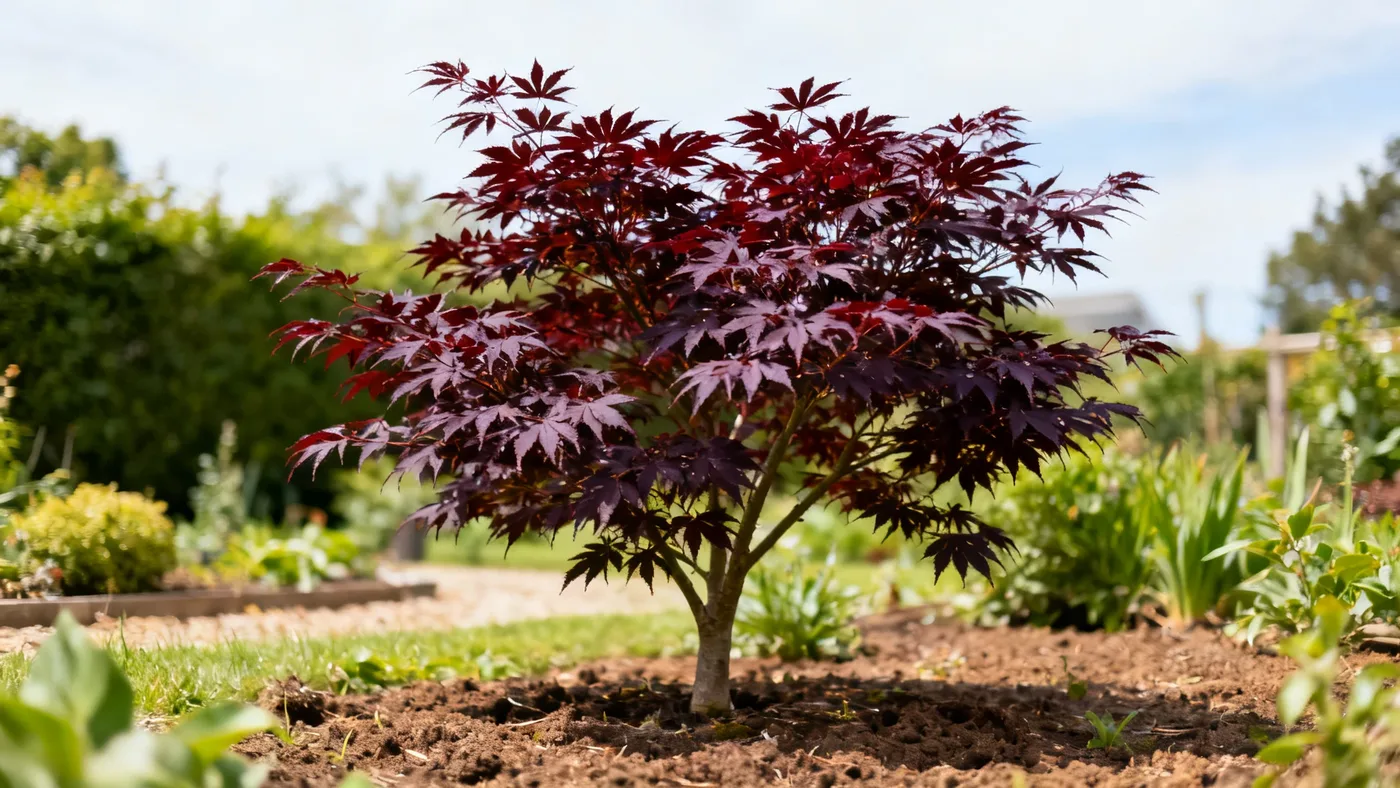
How Big Does a Bloodgood Japanese Maple Tree Get?
Whether you're planning a specimen tree for a small yard or spacing a cluster for a larger landscape, understanding how Bloodgood Japanese Maple grows is essential. This page answers the most common questions home gardeners and landscapers ask about size, growth rate, and maturity timelines.
Basic Size Questions
How tall does a Bloodgood Japanese Maple get?
Bloodgood Japanese Maple typically reaches 15 to 20 feet in height at full maturity. Some specimens can grow up to 20 to 25 feet over many decades with ideal growing conditions and excellent care. Height varies based on climate zone, soil quality, and how much sun and consistent water the tree receives.
How wide does a Bloodgood Japanese Maple spread?
The mature width of a Bloodgood Japanese Maple is typically 15 to 20 feet, roughly matching its height for a fairly upright, rounded canopy. This width assumes the tree grows in a naturalistic, unpruned form. If you're planting in a confined space, you'll want to account for this full spread when positioning the tree away from structures.
Is Bloodgood Japanese Maple a small tree?
Yes, compared to most landscape trees, Bloodgood Japanese Maple is considered a small ornamental tree. At 15 to 20 feet tall, it fits into most residential yards and works well as a specimen, patio, or foundation planting without overwhelming smaller properties. It's large enough to create a focal point but not so large that it dominates a modest landscape.
Can I grow Bloodgood Japanese Maple in a small yard?
Bloodgood Japanese Maple is well-suited for small yards, especially when spaced 12 to 20 feet from nearby structures and other trees depending on your desired mature width. Young trees start quite small and reach a landscape-usable size of 6 to 8 feet in about 5 to 7 years, giving you time to evaluate how the tree fits before it reaches full maturity. The slow to moderate growth rate means you won't be overwhelmed by rapid expansion.
Growth Rate and Timeline
How fast does Bloodgood Japanese Maple grow?
Bloodgood Japanese Maple has a slow to moderate growth rate, adding roughly 12 to 18 inches per year under good conditions. This pace is much slower than aggressive shade trees like maples or oaks, making it predictable for landscape planning. Growth speed depends on water availability, soil quality, and sunlight; trees in part shade or with inconsistent moisture will grow more slowly.
How long does it take for Bloodgood Japanese Maple to reach full size?
A Bloodgood Japanese Maple reaches full mature height and width in approximately 15 to 20+ years. During the first 5 to 7 years, it grows to a landscape-usable size of 6 to 8 feet, which is when most gardeners feel the tree is established and prominent enough to serve its intended purpose. After that, continued growth is steady but gradual.
Can I tell how big my Bloodgood Japanese Maple will get based on its current size?
Yes, you can use the growth rate of 12 to 18 inches per year as a rough guide, though actual growth will vary by climate and care conditions. If your tree is currently 4 feet tall, you can expect it to add 1 to 1.5 feet per year, so it will reach 6 to 8 feet in roughly 3 to 4 more years. For a precise timeline, track your tree's annual growth and adjust expectations based on local conditions.
What size is a nursery-grown Bloodgood Japanese Maple typically sold at?
Nursery-grown Bloodgood Japanese Maple is commonly sold in quart, #1 (1-gallon), or #3 (3-gallon) containers, depending on the grower and retail location. These typically range from 18 inches to 3 feet tall at the time of purchase. Larger specimens may be available but are less common; most gardeners buy younger plants and let them grow in place.
Spacing and Placement
How far from my house should I plant Bloodgood Japanese Maple?
Space a Bloodgood Japanese Maple at least 12 to 20 feet from structures, depending on the mature width you expect. This distance accounts for the full canopy spread at maturity and prevents root competition with foundation plantings or damage from debris falling near the house. If your planting space is tight, you can prune the tree to maintain a narrower profile, but the natural form is quite broad.
How far apart should I space multiple Bloodgood Japanese Maples?
Space individual trees 12 to 20 feet apart from center to center, depending on whether you want canopies to touch at maturity or remain separate. For a grove effect with distinct canopies, use the wider spacing; for a denser screen, use the closer distance. Remember that closer spacing increases competition for water and nutrients, so ensure consistent watering and good drainage.
Will Bloodgood Japanese Maple outgrow my landscaping plan?
The slow to moderate growth rate and 15 to 20 foot mature size are predictable, so as long as you've measured your space carefully and used the spacing guidelines, your tree should fit well. The main risk is underestimating width rather than height; be sure to measure 15 to 20 feet out in all directions from your planting spot to confirm clearance. If you're unsure, err on the side of more generous spacing; you can always fill in smaller plants nearby.
Container Growing
Can I grow Bloodgood Japanese Maple in a container long-term?
Yes, Bloodgood Japanese Maple is well-suited to container growing, especially when young, and many gardeners keep them in pots on patios or courtyards indefinitely. Container-grown trees remain smaller than in-ground specimens and are easier to manage and move. As the tree matures, you'll need larger containers and, in colder zones (5 and 6), winter root protection to prevent freeze damage.
How big will a container-grown Bloodgood Japanese Maple get?
A container-grown Bloodgood Japanese Maple typically stays somewhat smaller than in-ground trees due to root restriction, often reaching 8 to 12 feet tall depending on pot size and care. Trees in very large containers (20+ gallons) can approach in-ground dimensions, but most patio containers limit growth to the smaller range. Annual pruning can further control size and maintain the tree as a specimen focal point.
What size container do I need for Bloodgood Japanese Maple?
Start a young tree in a #1 or #3 container (1 to 3 gallons), then move up to a 5 to 7 gallon pot within the first 2 to 3 years as the tree grows and roots develop. For long-term container growing, use a 15 to 25 gallon container that allows room for soil, water drainage, and root expansion. The larger the container, the less frequently you'll need to repot and the more closely the tree's growth will approach in-ground dimensions.
Do container-grown Bloodgood Japanese Maples need special winter care in cold zones?
Yes, in USDA zones 5 and 6, container-grown Bloodgood Japanese Maple roots are more vulnerable to hard freezes than in-ground trees. Move the container to a sheltered location (against a south-facing wall, under an eave, or in an unheated garage) in winter, and wrap the pot with burlap or insulation to protect roots. This extra step is less necessary in zones 7 and 8, where winter temperatures are milder.
Regional Variations and Climate
Does Bloodgood Japanese Maple grow differently in different climate zones?
Bloodgood Japanese Maple is hardy in USDA zones 5 to 8, and some sources extend to zone 9 with afternoon shade. Growth tends to be most vigorous in zones 6 to 8 where summers are warm but not extremely hot. In zone 5, growth may be slightly slower due to shorter growing seasons, and in zone 9, afternoon shade becomes critical to prevent leaf scorch and summer stress.
Will my Bloodgood Japanese Maple grow as large in a cold zone?
In zones 5 and 6, your tree may grow slightly more slowly and reach full maturity a bit later than in warmer zones, but it should still achieve the standard 15 to 20 foot height and width. Cold-hardy cultivars like Bloodgood are selected for reliable performance even in cooler climates. Consistent watering and winter protection (mulch around the base) help ensure strong growth throughout the tree's life.
Does afternoon shade affect how big Bloodgood Japanese Maple gets?
Trees grown in afternoon shade, particularly in hot southern climates (zones 8 and 9), may grow slightly more slowly than those in full sun but often achieve similar mature dimensions. Shade helps prevent leaf scorch and reduces water stress in very hot summers, which can actually benefit long-term growth and health. If your tree is in part shade, allow extra time for growth and ensure consistent moisture during the growing season.
Long-Term Growth Considerations
How long does a Bloodgood Japanese Maple live?
Bloodgood Japanese Maple is long-lived, often surviving 80 to 100+ years or more with good care, regular watering, and well-drained soil. This means the tree is truly a long-term investment in your landscape; it may outlive many surrounding plants and structures. A well-established tree becomes a landscape anchor and improves in character and presence over decades.
Will my Bloodgood Japanese Maple continue to grow after 20 years?
Yes, the tree's growth slows considerably after reaching full maturity, but it will continue to add incremental height and width throughout its life. Annual growth becomes nearly imperceptible after year 20, and the tree's development shifts from vertical growth to densification of the canopy and thickening of the trunk and branches. This mature phase is when the tree's winter branching structure and overall form become most prominent.
Will I need to prune my Bloodgood Japanese Maple to control its size?
Minimal pruning is needed; the tree's natural form is attractive and naturally balanced. If you want to keep it smaller or shape it for a specific landscape role, prune in late fall to mid-winter while dormant to avoid excessive sap bleed. Remove only dead, crossing, or overcrowded branches; avoid heavy pruning in spring, which stresses the tree and disrupts its natural form.
What happens if I plant Bloodgood Japanese Maple too close to a structure?
Planting too close (closer than 12 feet) risks root competition with foundations, interference with gutters or siding as the canopy expands, and potential damage to nearby plants. If you've inherited a too-closely-planted specimen, you can manage it through careful pruning, but this requires ongoing maintenance and may compromise the tree's natural form. In most cases, it's better to relocate the tree while it's still young than to fight its mature size year after year.
Comparison and Context
How does Bloodgood Japanese Maple size compare to other Japanese maple cultivars?
Bloodgood is an upright cultivar that reaches 15 to 20 feet tall, making it taller than weeping forms like Crimson Queen, which typically stay under 12 feet. Other upright red cultivars like Fireglow and Emperor I are similar in size to Bloodgood. If you want a definitively smaller tree, look for dwarf selections, though most upright red maples fall in the 15 to 25 foot range.
Is 15 to 20 feet a good size for a specimen tree?
Yes, 15 to 20 feet is ideal for a specimen focal point in residential landscapes; it's large enough to command attention and establish vertical structure without overwhelming the property. This size also makes the tree accessible for care (pruning, inspection) and allows its deep reddish foliage and winter branching to be fully appreciated from a distance. For smaller yards, this is as large as trees typically go before they dominate the entire landscape.
Can I use Bloodgood Japanese Maple in a narrow side yard?
A narrow side yard is challenging because Bloodgood spreads 15 to 20 feet wide at maturity. If your side yard is only 10 to 12 feet wide, the tree will encroach on neighboring properties or structures and require constant pruning to fit. Consider a smaller specimen or a weeping form if you have a narrow space; these trade height for compact canopies better suited to tight quarters.
Quick Reference
| Characteristic | Specification |
|---|---|
| Mature Height | 15-20 ft (up to 20-25 ft over many decades) |
| Mature Width | 15-20 ft |
| Annual Growth Rate | 12-18 inches per year |
| Time to Landscape-Usable Size (6-8 ft) | 5-7 years |
| Time to Full Maturity | 15-20+ years |
| Lifespan | 80-100+ years with good care |
| Recommended Spacing from Structures | 12-20 ft |
| Container Suitable | Yes, especially when young; larger containers needed for mature trees |
| Hardy Zones | 5-8 (zone 9 with afternoon shade) |
| Common Nursery Sizes | Quart, #1, or #3 containers |
For more detailed care information, see The Complete Bloodgood Japanese Maple Care Guide.