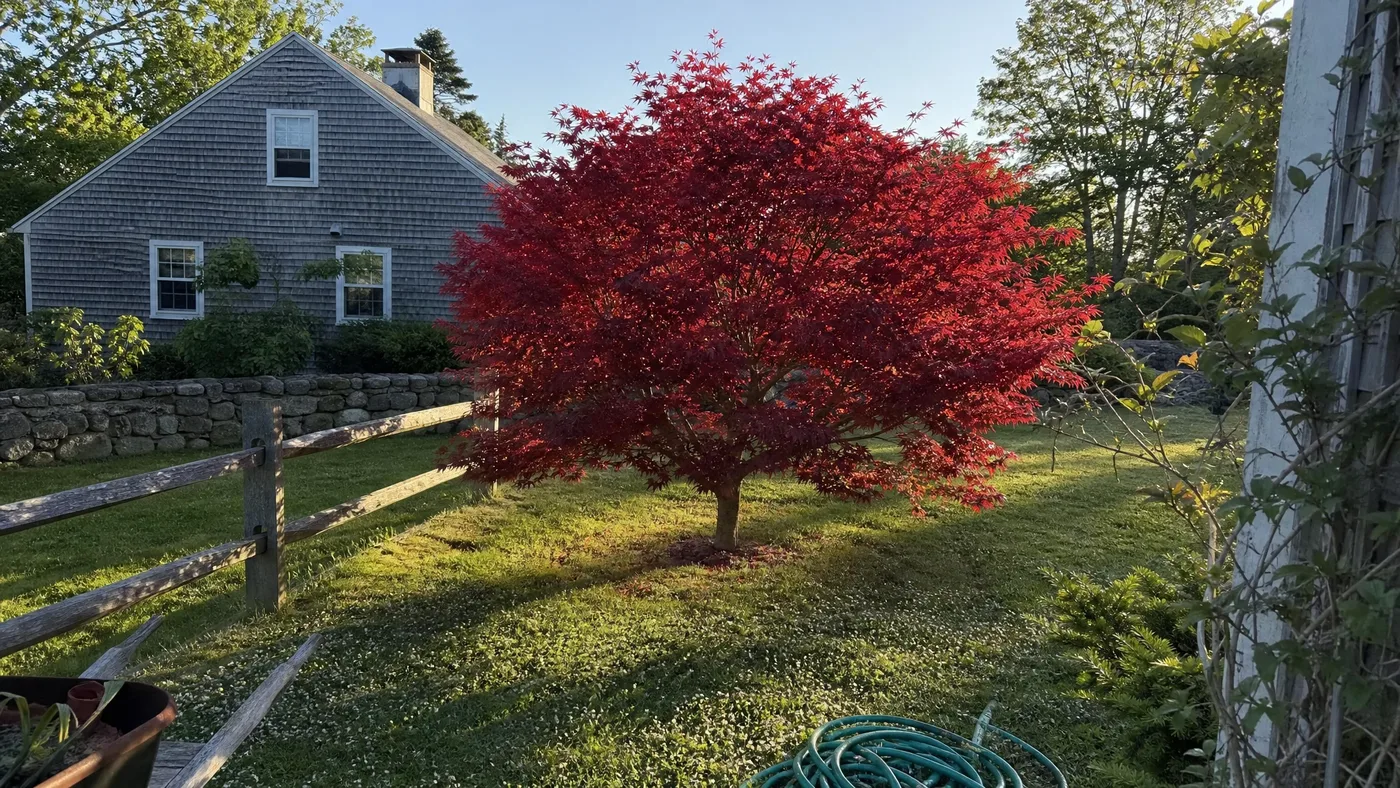
Bloodgood Japanese Maple Roots: Invasive? How Close to a House
By October, the top foot of soil under a young Bloodgood is busy. Hair-fine roots, many no thicker than thread, fill the loose upper layer where rain soaks in first and air reaches easily. They keep growing as long as the soil stays warm and damp. There is no single thick root plunging downward, and that one fact answers most of what people ask about houses.
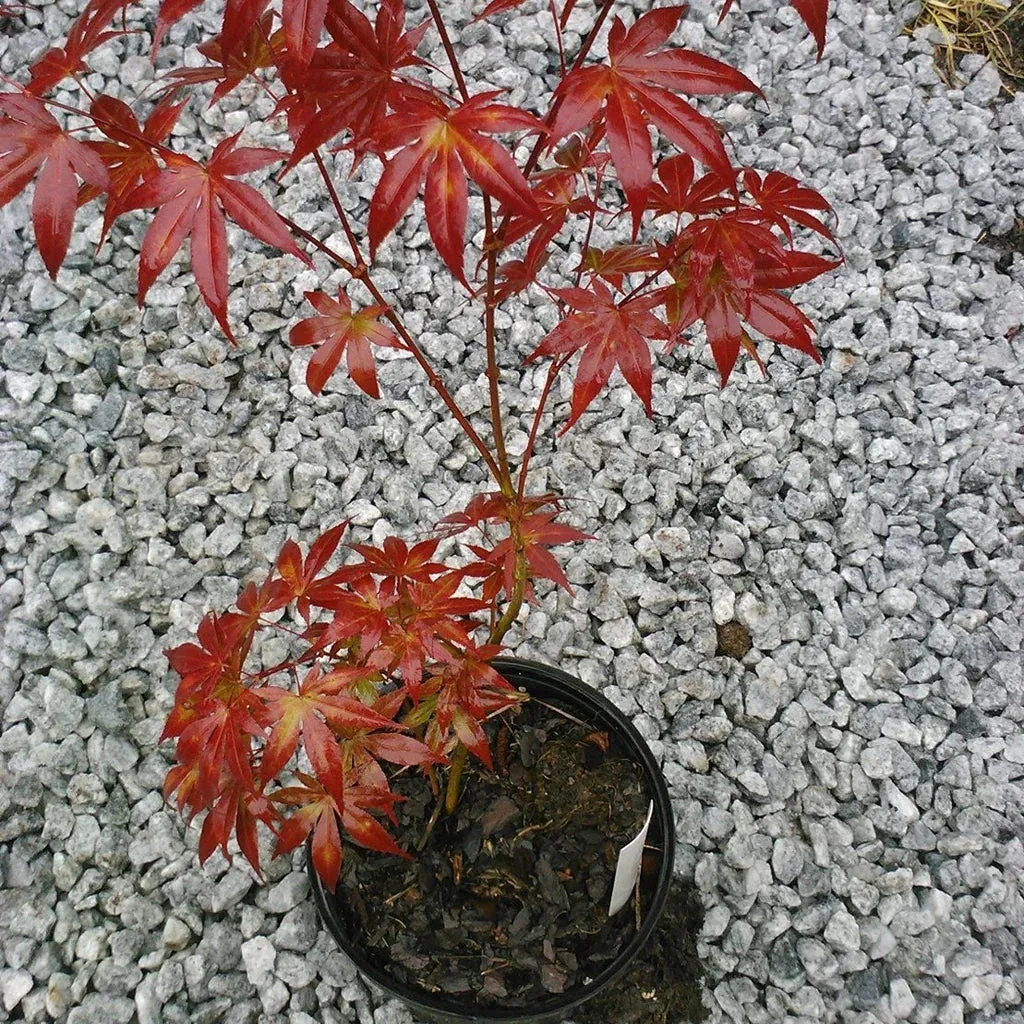
Autumn is also when most people plant, and when they stand in the yard holding a tape measure and wonder how close is too close. A wrong guess costs you a scorched, thirsty tree on one side or a cramped wall on the other.
This guide covers everything you need to know about Bloodgood roots, from how the fibrous system is built and why it rarely harms foundations, to pipes, paving, safe distances from the wall, plant neighbors, seedlings and the planting rules that follow.
How a Bloodgood Japanese Maple Builds Its Fibrous Roots
Everything else in this guide follows from how the root system is built, so we start there. The short version is a dense, shallow mat of fine roots rather than a few deep, heavy ones.
A Mat of Fine Roots Near the Surface
A fibrous root system is one made of many thin, branching roots instead of a dominant taproot. Japanese maples like their roots quite shallow, so the advice when planting is no more than 1 inch of soil over the main roots.
That advice tells you where the roots live. The fine ones that take up water and nutrients sit in the upper layer of soil, and the main roots that carry them lie close under the surface. Nothing in this tree is built to anchor itself by going deep.
Why the Roots Stay Near the Surface
Roots go where oxygen and water are both available, and in most yards that is the loose, organic top layer. Below it the soil is denser and holds less air, so fine roots thin out quickly with depth.
This also explains why a Bloodgood planted too deep struggles. Soil piled over the main roots cuts off the air they depend on. The cultivar shares the species' habit here, and none of our sources describes a different root form for Bloodgood, so we treat the two as the same in this respect.
How Far the Roots Reach
None of our sources gives a measured root spread for Bloodgood, so we will not invent one. What we tell customers is to treat the canopy as the minimum root zone and assume roots run at least that far. Cultivar listings give a mature width of 15 to 20 feet, so that zone is wide but thin.
Growth rate matters too. The species grows at a slow to moderate pace, and the roots expand at about the same pace as the branches. A tree you plant this fall will not have a yard-wide root system for many years.
Why Shallow Roots Rarely Split Foundations
Damage to a foundation takes force, and force needs mass. Here is why a Bloodgood root system usually cannot supply it.
Mass Is the Missing Ingredient
A root that cracks concrete is a thick, woody root that keeps gaining girth against a rigid surface. Bloodgood puts most of its effort into fine roots, and its trunk stays modest, with an ultimate height of 2.5 to 4 meters, about 8 to 13 feet. Other listings run to 20 feet. A smaller tree above ground means smaller roots below.
Compare that with a large shade tree that reaches many times this height. Its main roots can grow to the thickness of a person's thigh. A Bloodgood's never will, so the comparison people make with big street trees does not carry over.
Footings Sit Below the Roots
Shallow roots stay in the upper soil, where air and water are. A footing sits below that layer, in soil that is cooler, denser and drier. Fine roots have little reason to go there and little ability to push through it.
The One Realistic Risk
The honest exception is not root force but thirst. On shrink-swell clay, a tree pulling water from soil beside a shallow footing can dry that soil, and dried clay shrinks. This is far more of a concern with large, fast, thirsty trees than with a slow maple of 12 to 20 feet.
Customers usually ask us whether the roots will crack the basement wall. In our rows, when we lift a tree, we find a fibrous mat, not a heavy anchor. If your house sits on known reactive clay, ask your local extension service or a structural engineer before planting close. To see the tree's final dimensions first, read how big a Bloodgood gets.
What Pipes, Paving and Drains Actually Face
Lines and hardscape are a different question from foundations, because the risk comes from moisture, not muscle. Here is where trouble can still start.
Sewer, Drain and Irrigation Lines
Roots do not seek out sound pipe. They follow moisture and oxygen, and a loose joint or cracked old clay line leaks both. Fine roots slip into that opening and then thicken inside it. Intact modern plastic lines with tight joints give them little to find.
Our advice is practical. Learn where your lines run before you choose a spot, call your utility locating service, and keep the planting hole well out of the line's path. A Bloodgood is a poor choice directly over an old line you already suspect leaks.
Paths, Patios and Driveways
Because Bloodgood roots stay shallow, they can meet the thin base under a path. On a solid, well-compacted slab, fine roots have almost nothing to lift. Under loose pavers set on sand, shallow roots can nudge stones over many years, especially when the tree is the nearest source of moisture.
Leave a planting strip rather than planting into a paved edge. If a path must pass close, choose gravel or flexible edging that can be reset easily.
Drains, Downspouts and Wet Spots
A buried downspout line or a drain outlet is a steady water source, and roots will find it. Keep the trunk clear of where roof water is released. A Bloodgood likes moist, well-drained soil, and a spot that stays soggy near an outlet gives it the first without the second.
If a line must run near an established tree, dig by hand near the canopy. Cutting through the fine mat with a trencher removes the roots that feed the tree, and a young Bloodgood has few to spare.
Setting a Bloodgood Japanese Maple Back From the House
Distance is where roots and branches meet in practice. We work from the canopy, since that is the larger problem, and treat the roots as following it.
Walls and Footings
Our rule of thumb is to place the trunk at least half the mature width from a wall. With a width of 15 to 20 feet, that is roughly 8 to 10 feet. It keeps the canopy from pressing the siding and leaves the main roots well clear of the footing.
Go farther if you want the tree to show its full shape. A trunk set a bit beyond 10 feet gives the branches room to arch without brushing the wall. Our care guide also covers spacing from structures if you want a second view.
Eaves, Gutters and Windows
The wall itself matters more than the roots. A west or south wall throws back afternoon heat, and Bloodgood's thin leaves are prone to scorch at their edges. Siding that stays wet from the canopy is a second problem.
Choose a spot where the canopy can finish under, or clear of, the eave line, and where it will not drop leaves into gutters. Give it the space it needs now rather than a gap you have to prune into every year. Our pruning guide shows how much you can safely remove.
Reading the Site Before You Measure
A tape measure only gives half the answer. Look at which way the wall faces and where the afternoon sun lands in July. On the east side of a house, a Bloodgood can sit closer because it gets morning light and shade by afternoon.
On a west wall, add distance and consider some shade from a taller tree. Full sun to partial shade suits the cultivar, but it does best in dappled shade with protection from drying winds, and we lean toward the shadier side in hot places.
Neighbors a Bloodgood Japanese Maple Tolerates Underfoot
Shallow roots mean two things for companions. The tree is not a bully, but it also cannot win a contest for water in the upper soil.
Japanese maples prefer space for their roots and do best if they do not have to compete with the plants around them. So we treat tolerance as a limit, not an invitation to crowd.
Groundcovers and Perennials
Low, shallow-rooted shade perennials and groundcovers share the root zone without trouble if you plant them lightly and water the whole bed. Avoid anything with hungry, matting roots, and avoid trenching beds close to the trunk. Cutting through fine roots to plant is where most of the harm comes from.
Plant small divisions or plugs rather than large pots, so each hole disturbs little. Work with a hand trowel and stop if you meet a root thicker than a pencil.
Turf and Mulch
Lawn grass is the heaviest competitor, since its roots occupy the same upper inches. Keep a mulched ring around the trunk instead of turf right up to the bark. Spread mulch thinly, and pull it back from the trunk so the base can dry between rains.
Moisture is the point. The University of Florida's IFAS Extension rates the species' drought tolerance as moderate, so a shallow root zone that dries out will show it. Our watering guide sets out a schedule.
Seedlings and Suckers Around a Bloodgood Japanese Maple
People often ask whether a Bloodgood will spread through the yard. The answer differs for seeds and for suckers.
Self-Sown Seedlings
NC State Extension says the species self-seeds easily and can become weedy, and notes that the Mid-Atlantic Pest Council lists it as invasive in Virginia and DC. That describes the species, so check your state's guidance if you are in a sensitive area.
For a named cultivar, selections will not breed true. A seedling under your Bloodgood will not match its parent, so do not expect that deep red-purple leaf. Pull seedlings while they are small and easy to lift.
Suckers From the Roots
None of our sources describes Bloodgood sending up suckers from its roots, and we do not treat it as a habit of the tree. A shoot that appears low on the trunk is a different matter. If your tree is grafted, a shoot growing from below the graft union comes from the rootstock and will not carry Bloodgood's foliage. Cut it off at its base.
Planting Rules That Follow From the Roots
Each rule below traces back to the same fact: fine, shallow roots that need steady moisture. The link between the two is why the checklist reads the way it does.
Planting Checklist
Use this list when you mark the hole and set the tree. For the full process, see our planting guide.
- Plant so the main roots sit just under the surface, with no more than about 1 inch of soil over them, because that is where this root system works.
- Set the trunk at least half the mature width from the house, roughly 8 to 10 feet, and farther from any old or suspect pipe.
- Choose acid or neutral, moist but well-drained soil.
- Keep lawn and thirsty plants out of the canopy circle, and mulch in their place.
- Water the whole root zone through the first seasons, not just beside the trunk.
Fine Roots, Forgiving Neighbors, Steady Water
A Bloodgood's roots are fine and shallow, so they are forgiving to walls, paving and most neighbors. The same shallow, fine roots dry out quickly, so the tree asks in return for steady moisture and a ring of space. Give it both and the roots will stay where you put them.
Bloodgood Japanese Maple
Nursery-grown Bloodgood Japanese Maple in sizes from QT Container, shipped to your door.
From $49.49
Shop Now →Before a plant leaves us, we check that its roots are fibrous and evenly spread, that the main roots sit near the surface and that nothing is circling the root ball. As growers with our own farms, we sell only top-quality plants, and we think a Bloodgood should start with a root system you can trust.