Companion Plants for Bloodgood Japanese Maple: What Goes Under It
Under a maple canopy in its native woodland, the ground is busy. Fallen leaves pile into a soft litter, fungal threads run through the soil, and beetles, springtails and worms work the debris down into something the roots can use. A Bloodgood feeds in the top layer of that soil. Strip it bare, bury it under fresh topsoil, or plant something greedy over it, and the tree answers with scorched leaf edges, a thinning crown and slow, patchy growth.
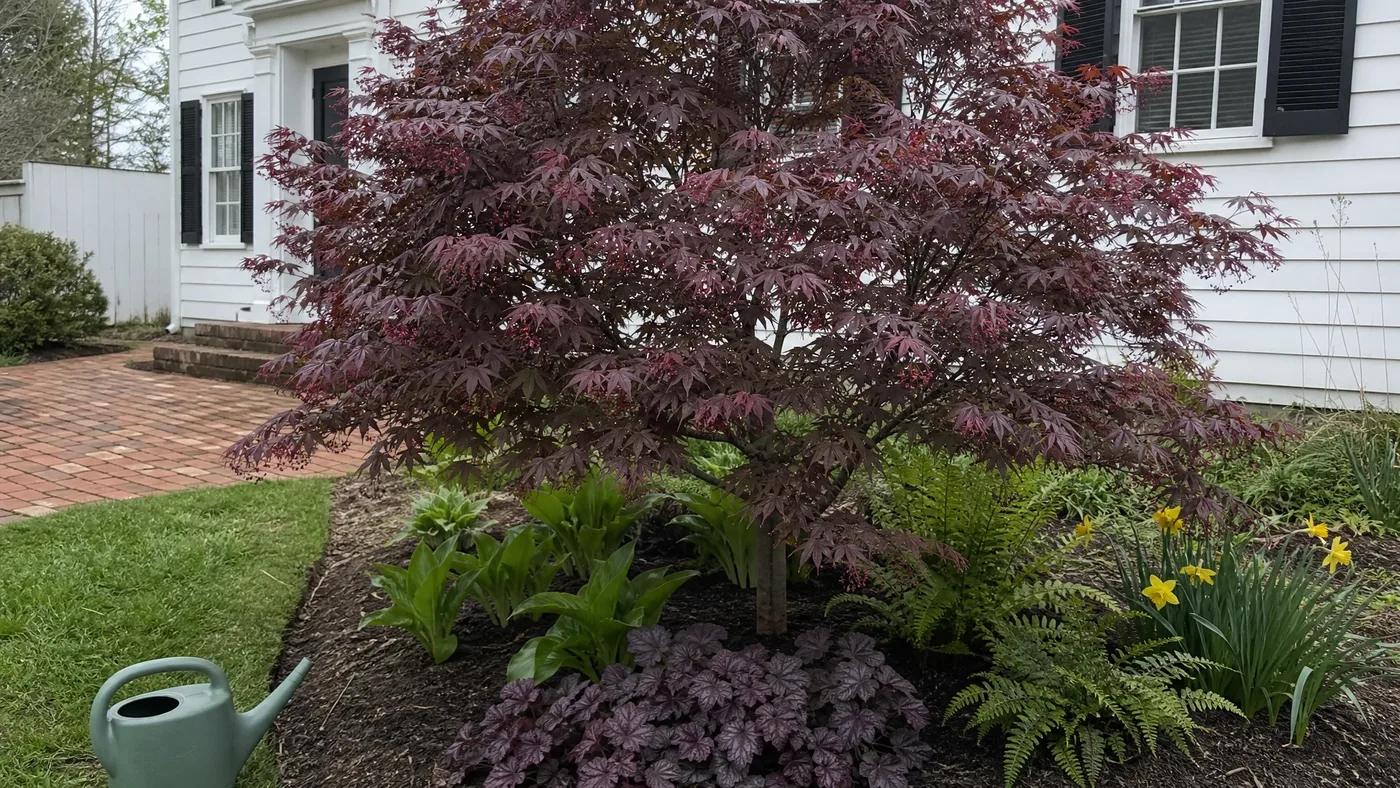
Underplanting done well rebuilds a little of that woodland floor without disturbing it. Below, you'll find out all about the conditions every neighbor must tolerate, including the hostas, ferns, heuchera, spring bulbs and groundcovers that suit them, the way to plant among shallow roots, and the plants that should never share the ground.
Light, Moisture and Roots Under a Bloodgood Japanese Maple
Every plant we suggest passes the same three tests, and all three come from the tree's own needs. Judge a candidate against them before you think about flower or color.
Dappled Light, Not Deep Shade
Light is the first test, and the one most often misjudged under a red-leaved tree.
NC State Extension advises planting Japanese maple in dappled shade and evenly moist, well-drained soil, with protection from drying winds. Red-leaved cultivars need some sun to develop rich leaf color, and this cultivar's color is best in partial shade although full sun can be tolerated. The species is green all summer, so the burgundy is a trait of this cultivar, and it drifts toward green when the light drops too low.
Our guide to Bloodgood light requirements covers the tree itself. For companions, the lesson is simple: they live in the shade the maple casts, and they must never add shade of their own.
Even Moisture
The second test is water, because the tree and its neighbors will drink from the same few inches of soil.
This cultivar does best in soil that is moist but well-drained. A neighbor that needs a bog will leave the soil too wet around the maple's roots, and one that wants dry, sunbaked ground will tempt you to stop watering during the weeks the maple needs it most. Choose plants that like the middle ground, and expect to water them all together in a dry spell.
Moist does not mean soggy. Soil that drains well and is covered by living leaves or a thin layer of litter holds its moisture longer than bare ground, and that is the real reason an underplanting helps the tree.
A Shallow Root Plate
The third test is the roots, and they set the rules for how you plant as much as what you plant.
Japanese maples like their roots quite shallow, with no more than 1 inch of soil over the main roots. A mature Bloodgood spreads about 15–20 feet wide, so the feeding zone is large, and every companion goes into that fibrous mat. That is why the planting methods below all use small holes, hand tools and thin layers.
Hostas and Ferns for Cool Shade
These are the plants that most resemble the woodland floor, and they ask for the same cool, evenly moist conditions the maple does.
Hostas Against Burgundy Leaves
Hostas give you a leaf shape that the maple lacks, which is why the pairing works.
The Bloodgood's leaves are deep red-purple and cut into 5–7 slender-pointed lobes. A broad, smooth hosta leaf in blue-green, or one with a pale margin, sits against that fine texture and makes the burgundy look darker. Gold hostas glow under the tree but need a little more light, so keep them toward the edge of the canopy where the shade is thinner.
Plant each crown in its own small hole worked between the roots, set at the same level it grew in the pot, and leave the soil around the trunk clear. Slugs are the usual complaint. A floor with ground beetles and toads in it holds them in check better than pellets do.
If you share your garden with animals, note that the ASPCA lists hosta as toxic to dogs, cats and horses. Our guide on whether Bloodgood is toxic to pets and children covers the tree.
Ferns That Unfurl With the Maple
Ferns are the other half of the woodland picture, and their timing suits this tree.
Fern fiddleheads rise and uncurl in spring, just as the maple's first leaves open, so the two seem to wake together. Lady fern, autumn fern, Japanese painted fern and Christmas fern all suit moist shade. Their creeping or clumping rootstocks stay shallow and do not compete hard, and the silver fronds of the painted fern are especially good against dark foliage.
One of the most common questions we get is whether ferns will tolerate maple roots. They will, as long as you choose woodland species rather than ones that need constant wet. Cut back last year's fronds in late winter, before the new croziers push through.
Heuchera Echoing Bloodgood Japanese Maple Foliage
Heuchera is where you choose color on purpose. Its leaves come in enough shades to either repeat the maple's burgundy or push against it.
Start from the tree. The foliage is deep burgundy in spring and summer and, as NC State puts it, turns bright crimson in fall. Heuchera planted at the edge of the canopy can pick up either of those notes. The table below sets out the three approaches we suggest.
| Goal | Heuchera foliage | Effect under the maple |
|---|---|---|
| Echo | Plum, purple or bronze leaves | Repeats the burgundy at ground level and ties the bed to the tree |
| Contrast | Lime, chartreuse or amber leaves | Lights up the dark canopy and pairs well with crimson fall color |
| Soften | Silvered or pale-veined leaves | Calms the bed and makes the dark leaves stand out |
We lean toward contrast for most beds. Dark heuchera right beneath a dark maple can merge into one heavy mass, especially in the shade of midsummer. Save the echo for the edges, where the light is a little stronger.
Heuchera forms small, shallow crowns, so it suits a Bloodgood. Set the crown at soil level and do not bury it, which matches the rule for the tree. Its roots stay compact, and a clump rarely needs dividing for years.
In late spring the slender flower spikes draw small bees, which is a quiet bonus. For ideas on placing this pairing in a wider border, see our landscape design ideas for Bloodgood.
Spring Bulbs Before the Canopy Closes
Bulbs solve a timing problem. They flower and finish while the Bloodgood is still bare or only just in leaf, then retreat before summer.
Which Bulbs Fit
The best choices bloom early and are small enough not to crowd the maple's lower branches.
Snowdrops, winter aconite, crocus, scilla and the smaller daffodils all flower in the weeks before the canopy fills. They also catch the first bees on warm days, when little else is in bloom. The Bloodgood's own flowers are small and red to purple, so they will not compete. Blue scilla beneath the bare twigs and unfurling leaves is a combination we like.
This is the same trick the woodland plays. Many forest bulbs finish their growing season in the weeks of full light before the trees leaf out, then rest through the shade of summer, which is exactly the rhythm a deciduous maple offers.
Planting Between the Roots
Fall planting is routine, but under a maple it needs a gentler hand.
Use a trowel and make individual holes, not a trench, at the depth on the bulb package. When you meet a thick root, move over and try again rather than cutting through it. After flowering, leave the foliage until it yellows, because the bulb is storing energy for next year. Hostas and ferns coming up beside them will cover the fading leaves.
Groundcovers That Knit the Soil
A groundcover does what leaf litter does in the wild. It shades the soil, slows evaporation and keeps the roots cool through the dry weeks of summer.
Low Spreaders That Behave
Not every spreader is a good neighbor, so choose slow, shallow-rooted plants.
Wild ginger, foamflower and barrenwort knit into a loose carpet without choking the soil. Moss does the same job on a damp, shaded site. Be wary of anything sold as fast, because speed usually means a plant that will outrun the bed and reach the trunk. You want a cover thin enough that rain and leaf fall still reach the ground below.
Planting Without Hurting the Roots
The method matters more than the plant here, since a groundcover bed is many small holes in the maple's root zone.
- Buy small pots or plugs, not large clumps, so each hole stays small.
- Dig every hole by hand and never rototill, which shreds the fine roots near the surface.
- Do not spread fresh topsoil to make the planting easier, since the tree wants no more than 1 inch of soil over its main roots.
- Water the whole bed in, then check it weekly through the first dry spell.
Common advice says to pile mulch several inches deep. We disagree under a maple. A thin layer of shredded leaves is enough, kept clear of the trunk, because the groundcover itself will do the rest. Our guide on planting a Bloodgood the right way explains the trunk flare you are protecting.
Plants That Fight a Bloodgood Japanese Maple for Water
Some plants make poor neighbors for any Japanese maple. These trees do best if they do not have to compete with the plants around them, so a short list of exclusions helps.
Thirsty, Aggressive and Deep-Digging Plants
The table below sorts the usual offenders by how they hurt the tree.
| Plant | Problem for the Bloodgood |
|---|---|
| Running bamboo | Spreading rhizomes invade the root zone and are very hard to remove |
| English ivy | Smothers the soil, climbs the trunk and holds moisture against the bark |
| Mint and goutweed | Spread by runners through the whole bed and take water first |
| Willow and poplar | Large, thirsty roots dry the soil well beyond the canopy |
| Full-sun perennials and roses | Want more light, water and feeding than the maple's shade allows |
The last row matters for a particular reason. Plants that want full sun push you to open up the canopy, and Japanese maples can be very prone to leaf scorch in windy or excessively sunny positions.
Why Lawn Is the Hardest Neighbor
Turf is the competitor we see most, and the one people accept without thinking.
We often see lawn mown right up to the trunk, with the grass roots packing the same top layer the maple feeds in. Grass takes water first and mowers nick the bark. Remove the sod in a wide ring and replace it with the plants above. For the full picture of how far those roots travel, see our guide to Bloodgood roots and how close to a house.
Honey fungus and Verticillium wilt are also possible problems for this cultivar, so a bed built over a rotting stump is a poor gamble.
What Lives Beneath a Bloodgood Japanese Maple
Put together, the planting is a small woodland community. Hostas and ferns hold the shade, heuchera carries the color, bulbs open the year, and groundcovers keep the soil dark and cool. Leaf litter feeds the fungi and the fungi feed the roots. Bees visit the early bulbs and the late spikes of heuchera, and beetles and toads shelter in the cover and keep slugs down. The tree needs only a ring of clear soil at the trunk.
Bloodgood Japanese Maple
Nursery-grown Bloodgood Japanese Maple in sizes from QT Container, shipped to your door.
From $49.49
Shop Now →Picture the bed in early spring, with snowdrops and crocus open in the leaf litter, fern fiddleheads rising and the maple's first leaves unfurling above them. That is the standard to aim for. Growing on our own farms keeps us a small business, and it means we handle each tree ourselves. Every Bloodgood we ship is potted in a firm root ball with its trunk flare near the surface and packed against knocks in transit, so it arrives ready to plant.