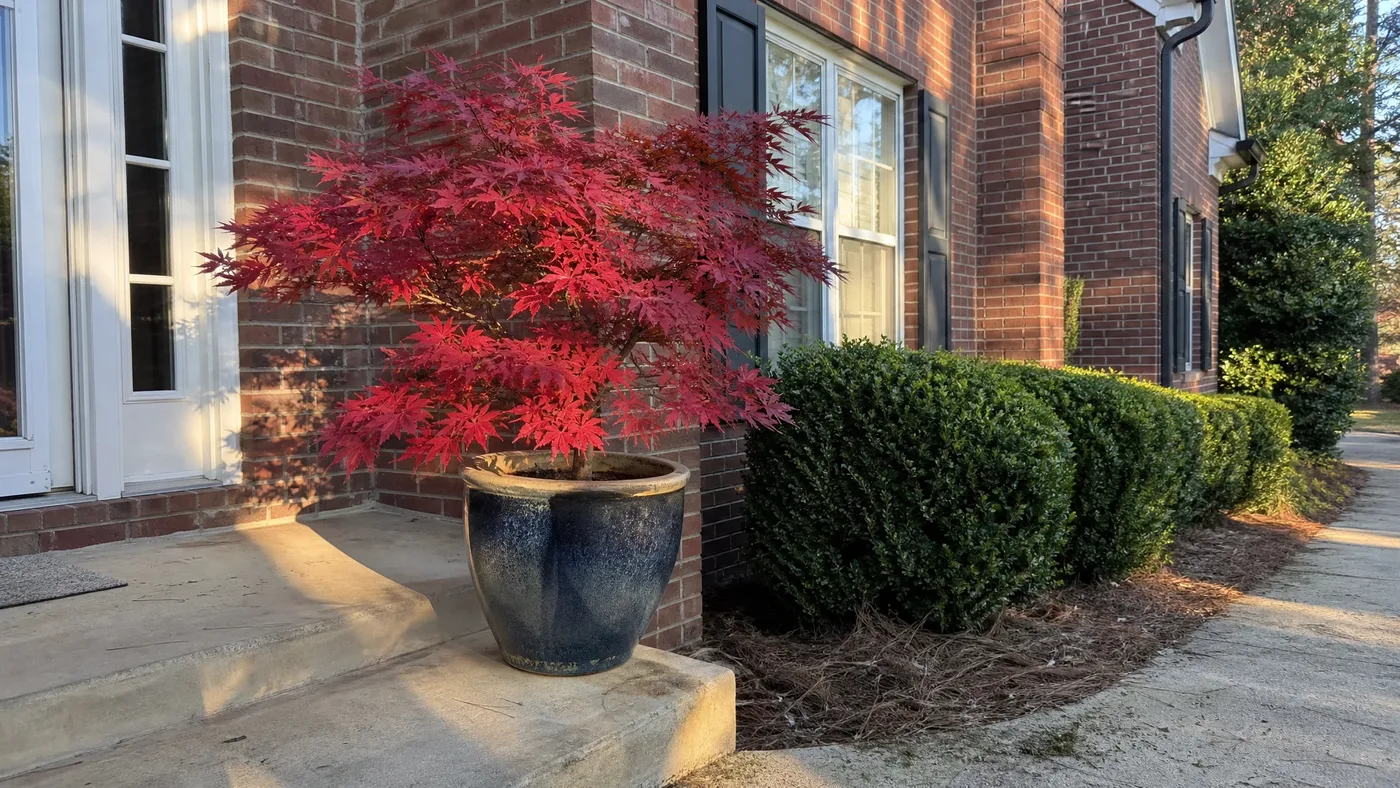
How to Keep a Bloodgood Japanese Maple Small and Compact
The first nursery tree we ever set in a 15-gallon pot was a Bloodgood, on a back patio, and we promised ourselves we would keep it small. Plenty of people make the same promise, believing that a big pot and a sharp pair of shears will hold the tree exactly where it is. What we see instead is a tree that keeps its own plans, filling the pot and throwing long shoots in early summer. Within a few years it leans on the doorway it was meant to soften.
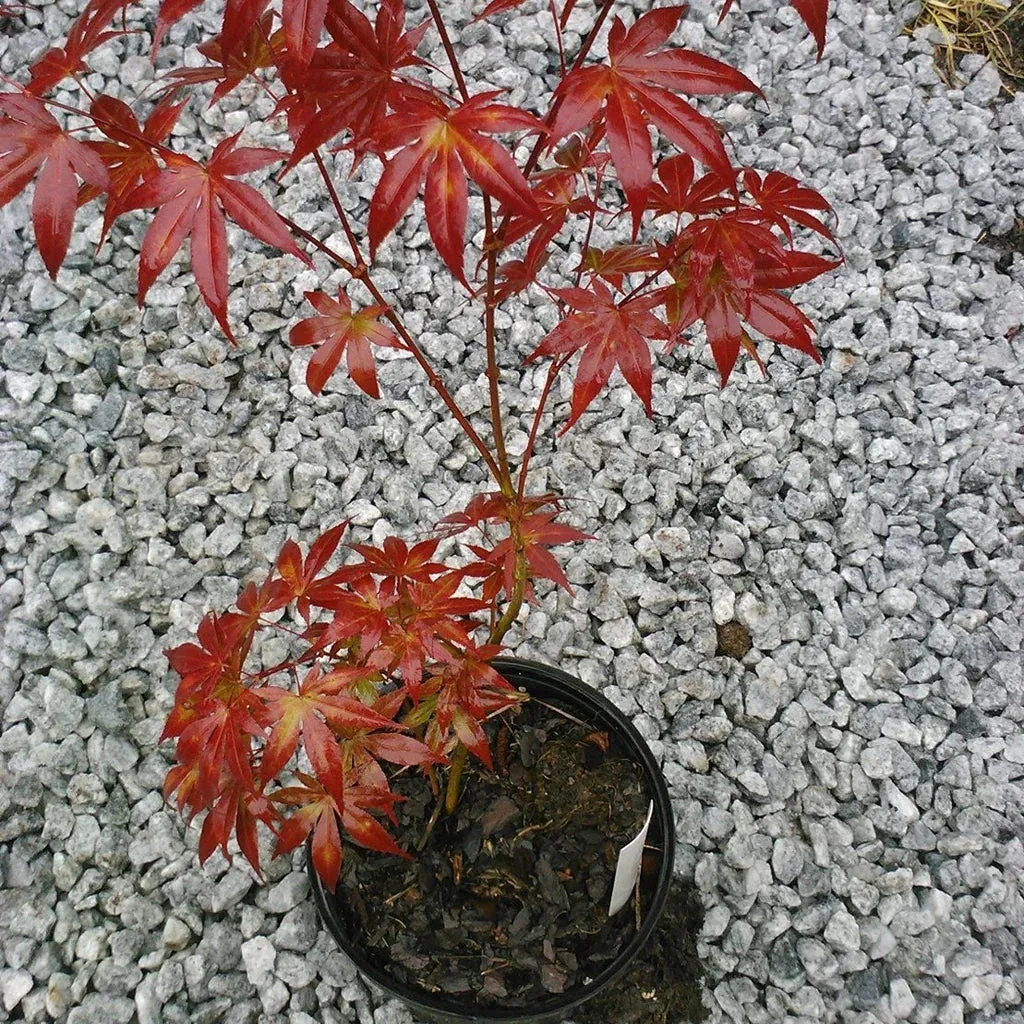
You can keep one compact, but only as a yearly routine rather than a single decision, and only if you accept the limits early. In this article, we'll go through that one tree and pot, from the first cuts and the root work every third spring to the sizes you can honestly expect, and the point where another maple is the better answer.
A Bloodgood Japanese Maple in a 15-Gallon Pot
Everything below follows a single tree, because the numbers and choices make more sense when they belong to one patio and one pot.
The Tree and the Spot
Here is the starting point, so you can hold it up against your own.
Picture a young container-grown Bloodgood, still a slender single trunk with a few side branches, moving up into a 15-gallon pot on a patio that gets sun in the morning and shade from the house by midafternoon. That exposure suits the cultivar. The deep red-purple leaves keep their color well in morning light, and the afternoon shade is what stops the edges from crisping in July.
A pot heats up faster than open ground, and that is the reason we chose the shadier side of the patio.
The Promise We Made
Every small-tree plan starts with a promise, and it helps to write yours down before the first cut.
Ours was modest. Stay below the roofline, leave room to walk past without brushing the leaves, keep the branches open enough to see through, and never shear the tree into a ball. One of the most common questions we get is whether the pot alone will do the job, and the honest answer is that it will not, which is the reason for everything that follows.
Our container-grown trees arrive with roots already used to a pot, so the move to a patio container is a gentle one. Decide where the tree will stand for the long haul before you plant, since a pot you must carry is a pot you will neglect.
Why a Bloodgood Japanese Maple Is Not a True Dwarf
Before you cut anything, know what you are working against, because the tree's genetics set the ceiling and your pot only nudges it.
NC State Extension says the cultivar can grow up to 20 feet tall and wide, at a slow to moderate pace. That figure describes a full-size small tree, and nothing in it says compact. You will see the word "dwarf" attached to Bloodgood in some listings, and we would not trust it.
What Slow Growth Does and Does Not Mean
Slow growth is the reason this plan works at all, and also the reason it fools people.
Clemson Extension puts the species at 10 to 15 feet in 15 years, a little faster in youth than later. A tree that slow takes years to outgrow a spot, so the first two or three seasons look as though the problem has solved itself. Then the trunk thickens, the framework lengthens, and the pot fills. Slow means you have time to manage the tree, not that you can skip the managing.
What Pruning Can Actually Do
Pruning controls size within limits, and it is better to learn them before you start than after.
The University of Arkansas Extension says Japanese maples may be pruned to control shape and size, and we agree, provided the cuts are selective. Pruning slows the canopy and shapes it, but it does not change what the tree is. A Bloodgood held small is a larger tree under constant, gentle restraint, and it needs that restraint every year for as long as you want the result.
This is also where the cultivar differs from the green-leaved species. Bloodgood is bought for its red-purple leaves and layered outline, and every cut you make has to protect that look instead of arguing with the tree's habit.
Site Matters as Much as Shears
Where the pot stands changes how hard you have to work, so choose the spot with the full-grown tree in mind.
A sheltered corner with morning light and afternoon shade slows the tree's stress and keeps the leaves intact. A hot, windy spot forces you to water constantly and to prune for damage rather than for shape. The species does best in dappled shade with moist, well-drained soil and protection from drying winds, and that advice holds even more firmly for a tree in a pot.
Pot, Mix and First Cuts in Year One
The first year is mostly about setting up conditions that slow the tree gently, and cutting very little.
The Pot and the Mix
Start with the container, since you will live with this choice for years.
Keep the tree in its 15-gallon pot and resist stepping up to a bigger one, because pot volume is your quietest size control. Use a mix that drains freely. A coarse, bark-heavy blend with some grit does that. Stand the pot on feet so the drainage holes never sit in water.
A small pot dries fast in summer, so check it often with a finger pushed down into the mix. Our guide to growing Bloodgood in a pot covers the wider container questions.
The First Cuts
Early pruning should be light, and it should be about structure rather than size.
In the first winter, remove only dead twigs, shoots that cross, and anything rubbing the main stem. Prune in February while the tree is dormant, when the bare branches let you see the framework clearly. Decide now which handful of main limbs will form the skeleton, because the whole small-tree plan hangs from them. Do not shorten those limbs yet.
Let the tree build a sound structure first, then start steering it. Our guide to training a young Bloodgood goes further into those early choices.
Pruning Through the Seasons as the Pot Fills Out
From the second year on, the work settles into one real session while the tree is bare and a light touch once the leaves are open.
Cuts That Shape the Frame
The dormant stretch is when you make the cuts that matter, so take your time with them.
Work from the inside out. Take out a branch pointing into the center, then one that doubles another, then step back and look at the outline. The extension service suggests you try not to remove more than one third of the limbs, cutting at the branch collar or at a node where buds can fill back in.
In our rows, we usually take far less than a third. Make selective cuts to reduce size instead of clipping the outside, because shearing only grows a thicket of weak shoots and ruins the layered look.
Light Tip Work After the Leaves Harden
A second, lighter pass keeps the tree from running away between winters.
Once the first flush of leaves has fully opened and firmed up, shorten the longest shoots back to a pair of leaves. This pushes energy into the interior and keeps the horizontal tiers that make the tree worth growing. Skip heavy cuts in hot weather, since they leave fresh wounds on a tree already working hard.
Our pruning guide covers technique, and this routine is the size-control layer on top of it.
What to Leave Alone
Restraint is part of the method, and a few habits do more harm than good.
Do not top the tree to drop its height in one move. A topped Bloodgood answers with a crowd of upright shoots that are harder to manage than the branch you removed. Reduce height by cutting a long limb back to a side branch that points the way you want, a little each winter. Patience here costs you nothing and keeps the tree looking like a tree.
Root Pruning a Bloodgood Japanese Maple Every Third Spring
Canopy pruning alone cannot sustain a tree in a fixed pot, because within a few years the roots fill the container and begin to circle.
Root pruning resets that, and it also holds the top in check, since a trimmed root mass cannot support unlimited new growth. Do it every third spring, in the weeks before the buds swell, when the tree recovers best.
The Steps
Have everything ready before the tree leaves the pot, and work in this order.
- Water the tree the day before, so the root ball holds together.
- Lay the pot on its side and slide the tree out, or cut the pot away if it is stuck.
- Comb out the outer roots and cut away any that circle the ball.
- Saw a slice from the sides and bottom of the root ball with a clean blade, leaving a healthy core.
- Refill with fresh mix, set the tree at its old depth, and firm it in.
- Water slowly until it drains from the holes, then move the pot into shade for a few weeks.
Aftercare
The weeks after root work decide whether it was a success.
Keep the mix evenly moist but never soggy, and shield the tree from drying wind and hot afternoon sun. A trimmed root system cannot keep up with a full canopy in a heat wave, and leaf scorch is the usual warning. In a year of root work, hold back on canopy cuts and let the tree spend its energy on new roots.
If you skip a cycle, you will know. Water runs straight through, the mix shrinks from the pot wall, and the tree sulks in July.
How Small a Bloodgood Japanese Maple Stayed Over Ten Years
This is where honest ranges matter, because height depends on the pot, the site, the pruning and the weather, and we would rather give you a range than a tidy promise.
The published figures describe trees growing without this kind of restraint, and they differ by source.
| Source | What it says |
|---|---|
| NC State Extension (cultivar) | Up to 20 feet tall and wide |
| Size | 2.5 to 4 meters, about 8 to 13 feet, ultimate height |
| Clemson Extension (species) | 10 to 15 feet in 15 years |
A potted, pruned and root-trimmed Bloodgood should sit at the low end of that spread, or below it, for its first ten years. Some potted trees stay close to the patio roofline and others climb past their owners, so treat any single number with suspicion.
Measure It Yourself
Your own tree is the only data that counts, and it takes a few minutes a year to collect.
Each February, stand a pole beside the tree, mark the height, and note the widest spread of the branches. After three or four winters you will know your own rate, and you can set your cutting to match it. Our size guide shows the unrestrained picture for comparison, and your local extension service can tell you how the tree behaves in your climate.
Knowing When to Choose a Different Maple
There comes a point where the tree is telling you the space is wrong, and the kinder move is to listen.
Signs You Are Fighting the Tree
Watch for these, because they usually show up together.
- You must remove more than a third of the limbs each winter just to hold the line.
- Cuts leave stubs and bare patches instead of filling back in at the nodes.
- The canopy scorches even with afternoon shade, because the root ball is too small to feed it.
- You are root pruning more often than every third spring.
Picking a Better Fit
If two or three of those are true, switch trees instead of cutting harder.
The University of Florida advises that a Japanese maple looks best if it is not pruned to control size, so choose a cultivar whose natural form already fits the spot. We compare a lower, weeping alternative in Bloodgood vs Crimson Queen. A tree that fits needs less work every year, and it looks better for it.
A Bloodgood Japanese Maple in Autumn, Pot Unchanged
A Bloodgood can be kept compact for a decade or more, but only as a patient practice made of a pot that stays put, light cuts each winter, tip work in summer and root work every third spring.
Bloodgood Japanese Maple
Nursery-grown Bloodgood Japanese Maple in sizes from QT Container, shipped to your door.
From $49.49
Shop Now →By late October the leaves have turned crimson, the patio is quiet, and the tree in its pot looks like the small one we hoped for. What we would do differently is start the root work a year sooner and cut a little every winter from the beginning, instead of waiting for the first crowded summer. We grow and sell top-quality trees on our own farms. Customers come back to us each year for Bloodgoods with sound roots and good branching, the kind that take well to a pot and to patient shaping.