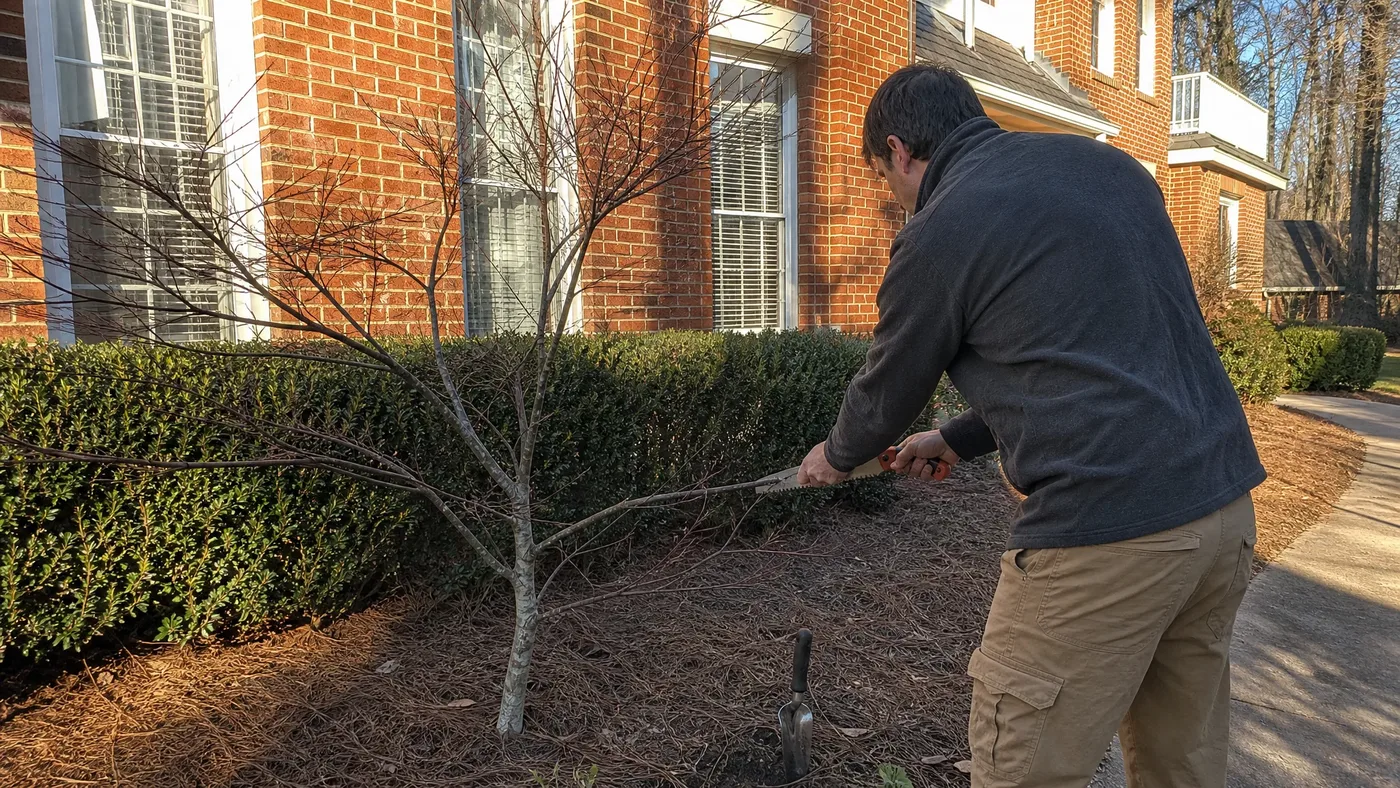
Training and Shaping a Young Bloodgood Japanese Maple
Most buyers expect a Bloodgood to arrive as a finished shape and simply grow bigger. It never worked that way. The story starts in the Japanese nurseries and Dutch plantations where Bloodgood was first selected and grown as a shaped specimen, and its look was always a product of selection plus hands-on form training.
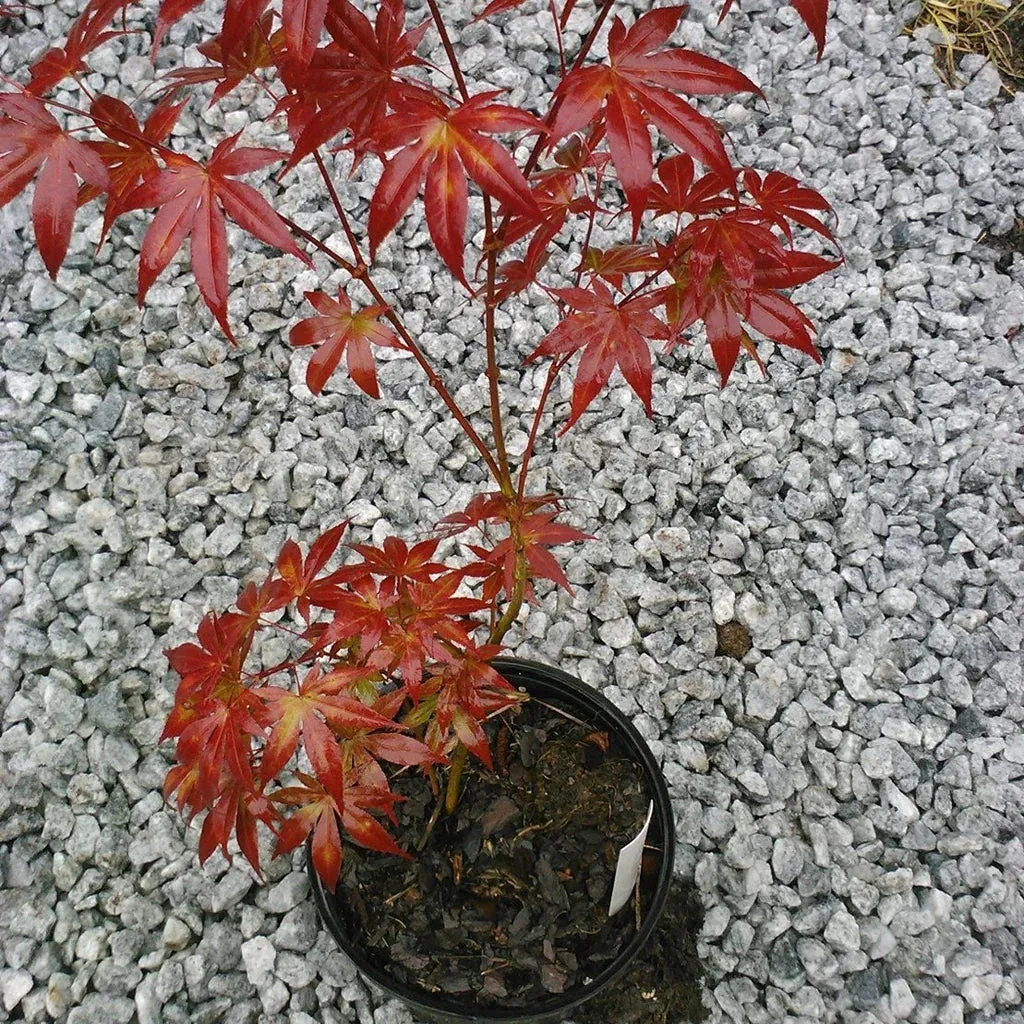
Left alone, a young Bloodgood drifts toward a bushy mound of competing stems. A few early decisions turn it into a tree with a clear trunk, spaced limbs and visible layers. Skip them, and the same fixes get much harder in year fifteen.
In this article, we'll go through choosing scaffold limbs, removing the low branches in stages, deciding between one trunk and several, and thinning for the layered look.
Why Bloodgood Japanese Maple Was Always a Shaped Tree
Before you pick up pruners, it helps to know what you are trying to finish. Bloodgood has never reached its good looks on its own, and its history shows why a little deliberate shaping suits it.
Selection Fixed the Color, Not the Form
Selection gave Bloodgood its leaves: deep red-purple, with 5–7 slender-pointed lobes, turning red in autumn. It is also a large bushy deciduous shrub, and that word matters. A young plant left alone sends up several stems of similar strength and fills in from the ground, so the tree shape has to be asked for.
Its ultimate height is 2.5–4 meters, about 8 to 13 feet, though some US sources run taller. Read our guide on how big a Bloodgood gets before you plan around one number. Either way, you are shaping a small tree, and every cut stays visible for years.
Why Trained Form Became Part of the Identity
The Japanese nurseries and Dutch plantations that grew Bloodgood worked on young plants while they were still small. They trained them toward a clear trunk, spaced limbs and an open crown. That trained look is what buyers came to expect from the cultivar, and it is what most photographs of mature specimens show.
The species gives you the pattern to work toward. It has a layered look with a low, dense, rounded top and spreading branches, and UF/IFAS lists it at 10 to 20 feet.
Bloodgood's dark foliage makes those layers easier to read than on a green tree, because the gaps between tiers show as clear light. Our position is simple: shape it early and lightly, and treat the shaping as part of the plant, not as a repair job.
What Old Nursery Habits Teach a Bloodgood Japanese Maple Owner
Nursery growers had no secret tools. They had habits, and most of them carry over to a single tree in a yard once you drop the production schedule.
Habits Worth Copying
These four cost nothing and protect the tree from the usual early mistakes.
- Look before you cut. Watch how the tree branches through one full growing season. Nurseries decide from what a plant has shown them, not from a picture of the finished tree.
- Cut little, and cut often. The advice for young Japanese maples is to remove only badly placed or crossing shoots and let a good framework of branches develop.
- Cut back to a side branch. Never leave a stub, because stubs tend to decay and die back.
- Keep a record. Photograph the tree from the same spot each winter, so you can see what last year's cuts did.
Habits to Leave Behind
Nurseries prune to a deadline, because a tree has to be sellable by a certain season. You have no deadline, and the species grows at a slow to moderate pace, so the tree will not repay hurry.
Heavy, fast training is a nursery shortcut, and it is the wrong model for one tree in your yard. Take the patience and leave the speed.
One of the most common questions we get is how soon to start. What we tell customers is to wait until the tree has settled in and put on a full season of growth after planting. Our planting guide covers that first season, and whatever tree you begin with, ours included, give it that season before the first cut.
Choosing Scaffold Branches on a Bloodgood Japanese Maple
Scaffold limbs are the permanent branches that carry every tier. Choose them once, choose them well, and most later pruning becomes light tidying.
How Many to Keep
Aim for three to five. Fewer than three leaves obvious gaps in the layering. More than five, and Bloodgood's dense twiggy growth packs the tiers together until they read as one mass. Pick candidates in winter, after leaf drop, when the whole structure is visible against the sky.
Picking Them Step by Step
Work through this order, with tape to mark the limbs you intend to keep.
- Stand back and find the leader. If a strong vertical shoot is competing with it, cut it back to a side branch in late autumn.
- Mark one candidate limb for each direction around the trunk. Two limbs facing the same way will shade each other.
- Check the angle. Favor limbs that leave the trunk wide and open, closer to level than upright. A tight V-shaped union, with bark pinched into the crotch, is weak and should not be a scaffold.
- Check the spacing. Stagger the limbs up the trunk so each sits above and to the side of the one below. A ring of limbs from one point on the trunk is the layout to avoid.
- Check the graft. Most cultivars are grafted, so your scaffolds should sit well above the graft union. Remove any shoot that comes from below it, since that is rootstock. Our guide to grafted versus seedling Bloodgoods shows what to look for.
What to Do With the Rest
Limbs you did not tag are not all cut on day one. They stay as temporary branches and come off on the schedule in the next section. Only the badly crossed or rubbing ones go now.
Lower Limbs Come Off in Stages
Low branches are the part of a young Bloodgood people want gone first. Plan their removal as a budget spread over several winters, not a single afternoon's work.
Why Not All at Once
Every branch you remove takes leaf area with it, and this is a slow to moderate grower. We often see a Bloodgood limbed up in one session that then sulks for two seasons with a thin crown and a long bare trunk. Spreading the cuts keeps enough foliage working while the trunk thickens.
A Cut Budget Across Winters
This table lays out one reasonable pace. Adjust it to the tree, and slow down if growth has been weak.
| Stage | What comes off | Why then |
|---|---|---|
| First winter | Crossing or rubbing twigs, plus any rootstock shoot below the graft | These cost the tree almost nothing |
| Second winter | The lowest limb that is not a scaffold | The upper crown has had a season to fill in |
| Third winter | The next lowest non-scaffold limb | The trunk has thickened and the cut wound is small |
| Later winters | One remaining low limb at a time, if the tree is growing well | Foliage stays in balance with the roots |
Making the Cut and Knowing Where to Stop
Cut during dormancy and remove the whole limb at its base. Do not leave a stub, which is prone to decay. Work from the lightest, smallest limb up to the largest.
Stop when you can walk or mow under the lowest scaffold. Bloodgood branches arch outward and sag as they lengthen, so leave more clearance than the young tree seems to need.
One Trunk or Several for Your Bloodgood Japanese Maple?
Most cultivars are grafted and can be grown as a single or multi-stemmed small tree. Both forms work for Bloodgood, and each costs something different.
The Single-Trunk Case
A single trunk gives you the classic picture: clear ground beneath, limbs stepping up in tiers, and room for ferns or hostas underneath. It suits a narrow bed or a spot beside a path. The trade-off is time. It takes longer to look finished, and one damaged trunk means starting over.
The Multi-Stem Case
A multi-stem tree fills out sooner and looks softer, which suits a corner or a screening role. It is also a form of insurance, because losing one stem leaves the tree standing. The costs are width at the base and tight unions between stems. Keep the stems few, spread them apart, and remove any that grow in close and rub.
A Plain Way to Decide
Go with a single trunk if the tree is a focal point and you have the patience for the tiers to develop. Choose multi-stem if the planting needs bulk in a few years, or you have a tight corner that wants fullness.
Wind matters more than form in the end. The species needs protection from drying winds, and either form suffers on an exposed site. Ask your local extension service how ice and snow loads affect your area before you commit to one form.
Thinning Toward the Layered Look
Once the scaffolds are set, thinning is the work that makes the layers visible. The goal is to see light between tiers and clear horizontal lines in the limbs.
What Comes Out of a Tier
Take out the shoots that fight the layering: those growing straight up through a tier, those pointing inward toward the trunk, and those crossing another twig. If one twig sits directly above another, remove the one that blocks the lower. Each cut goes back to a side branch, never to a stub.
Do this in winter. Without leaves, you can see the real structure, and Bloodgood's dark foliage hides it completely in summer.
Check Your Work From a Distance
After a round of cuts, step back and look at the silhouette. You should see sky through the gaps between tiers and a limb line that runs close to horizontal. If the outline still reads as a single dense ball, take out a few more crossing twigs and check again. Our guide to what a Bloodgood looks like shows the mature form to aim for.
Pace the Light
Thinning also lets sun into the interior, and leaves that grew in shade can scorch when they are suddenly exposed. Bloodgood suits full sun to partial shade, but a hot afternoon is still where scorch shows first.
On a hot, sunny site, spread your thinning over two winters rather than one. Our guide to Bloodgood light requirements explains how to read your site.
What a Bloodgood Japanese Maple Costs in Patience
Shaping asks for one quiet afternoon each winter, a sharp pair of bypass pruners, a small saw for the larger limbs and a roll of tape to mark your choices. The yearly spend is small. Bloodgood takes 10–20 years to reach maturity. You will not see the finished tree for a long time, but the structure will show itself from about the third or fourth winter.
Bloodgood Japanese Maple
Nursery-grown Bloodgood Japanese Maple in sizes from QT Container, shipped to your door.
From $49.49
Shop Now →That is the plain accounting: a few deliberate cuts early buy decades of structure. For maintenance after the framework is set, see our guide to when and how to prune a Bloodgood. We are growers with our own farms, and Customers come back to us for Bloodgoods with deep red-purple leaves and good bones, the kind that repay a few careful winters.