What a Bloodgood Japanese Maple Looks Like: Leaves, Bark, Form
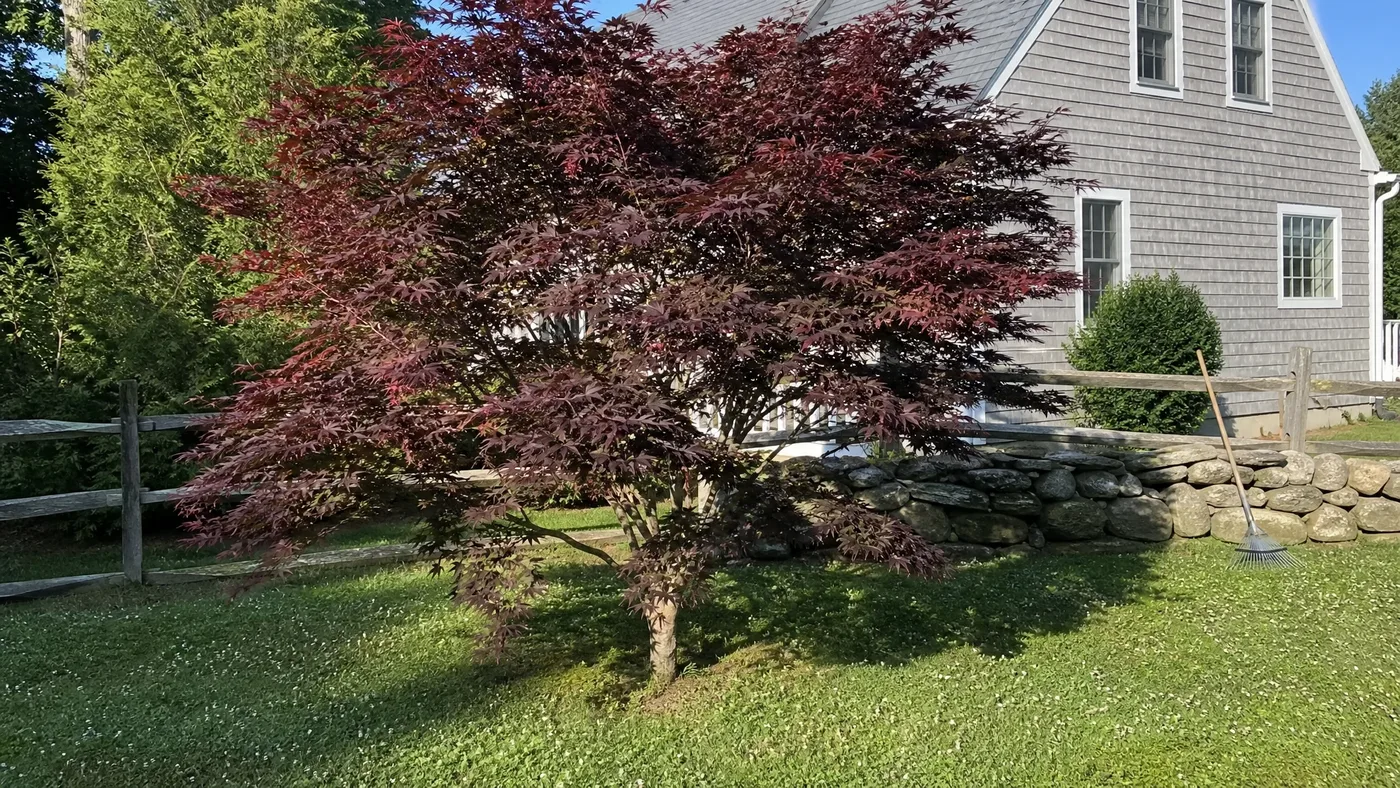
Twenty feet is how far we tell customers to stand back before they look at anything else. A mature Bloodgood spreads about 15 to 20 feet wide, so from twenty feet you take in the whole crown. Three numbers then settle most of the identification: height, spread and leaf color. Up close you lose the shape, and several red maples look alike at arm's length.
This article talks about how a Bloodgood Japanese Maple looks, from the view across the lawn down to a single leaf, and answers the questions customers ask us most. Read on to learn how tall and wide the tree stands, how its crown shifts from vase to round, what the bark, young twigs and seeds look like, and which three checks confirm the tree.
Getting this right matters. Plant the wrong red maple and you get a different size, a different shape and sometimes a different color by August.
The Bloodgood Japanese Maple Seen From the Street
The widest view gives you size, habit and color. Start with the numbers, then look at how the tree sits against what is behind it.
Height and Spread
Figures vary by source and by site, so treat them as a range. Purdue gives 12 to 20 feet tall and 15 to 20 feet wide for the cultivar.
The table below sets the cultivar next to the green species, which runs larger and looser. Growth in the species is slow to moderate, so a tree at the top of these ranges is many years old.
| Trait | Bloodgood | Green species |
|---|---|---|
| Height | 12–20 ft | 15–25 ft |
| Width | 15–20 ft | 10–25 ft |
| Summer leaf color | Deep red-purple | Green |
Width is the number people underestimate. A Bloodgood is nearly as wide as it is tall, so it needs room on both sides. Our guide on how big a Bloodgood gets covers the growth years in detail.
How the Burgundy Reads
Color depends on the backdrop, and this is where placement pays off.
Burgundy is dark, so it shows best against pale siding, light stone or a lawn. Against dark brick or a shaded fence the tree turns into a silhouette, and you see form rather than color. From the street the crown reads as one dense, dark mass, with few gaps where the sky comes through in summer.
Light changes the reading too. Leaves in the brightest part of the crown often look a shade different from those inside. Judge the tree as a whole, not by the one branch the afternoon sun is hitting. In our rows, customers who stand twenty feet back in July usually stop asking whether it is the right red.
A Crown That Shifts From Vase to Round
Moving in to the crown, the main change is time. A young Bloodgood and a twenty-year-old Bloodgood do not share an outline.
The Young Vase
Young trees send their branches up and out at a steep angle, so the outline is narrow at the base and wider at the top, like a vase.
The leader and main limbs rise rather than spread. In the first years you see daylight between branches and a fairly open frame. This is the shape you see in a container, and it is the one buyers sometimes mistake for the final form. A young tree looks narrower than its tag promises, and that is normal. If you want to guide it, our guide on training and shaping a young Bloodgood explains which limbs to keep.
The Older Round Crown
With age the limbs thicken, lean outward and begin to arch under their own weight. The top fills in.
The mature shape is round, broad, and upright with dense spreading branches. That fits what we see. The vase gives way to a rounded dome, still upright, but much wider than the young tree suggested.
The same source notes a layered branching structure. The layers are easiest to see in winter, when the limbs stand out in tiers instead of hiding behind leaves. Count the tiers from the ground up. Each one is a set of side branches running roughly level, and together they give the dome its steps.
What the Crown Rules Out
The crown is a quick way to eliminate look-alikes.
A weeping or mounding form is not a Bloodgood. If the crown droops to the ground at ten years old, you are looking at a different cultivar. The same goes for a tree that stays narrow and columnar with no spread at all. A Bloodgood always widens.
Gray-Brown Bark of a Bloodgood Japanese Maple
The trunk is the part of the tree you see all year, so it is worth knowing what it should look like.
Bloodgood is usually multi-trunked. Several stems rise from near the ground and spread apart, rather than one clean central trunk. The effect is muscular-looking, and that is accurate once the stems pass a few inches thick. They swell at the base and flare where they split.
Color and Texture
Mature bark is gray with a brown cast, and the texture is rugose, meaning ridged and wrinkled. UF/IFAS describes the species the same way: gray bark with rugose texture. Young stems are thinner and smoother, with a reddish tint that fades to gray as the wood ages.
Look at the point where stems leave the ground. That is the oldest wood on the tree, and it carries the roughest texture. Higher in the crown the branches get smoother and redder until you reach the twigs.
What Bark Does Not Tell You
Bark alone will not separate a Bloodgood from a green-leaved Japanese maple. The species is also multi-trunked with gray bark, so the trunk helps you rule out single-stem trees, but it does not confirm the cultivar.
Use the trunk as a supporting check. If a tree has one straight trunk with deep furrows, it is probably not a Japanese maple at all. Pair the trunk with the leaf and the twig before you decide.
Red Twigs and Paired Samaras
The next step in is the youngest wood and the seeds. Both are small, and both are reliable.
The Current-Year Twig
Look at the growth made this season. The current-year stem is thin and reddish. On a Bloodgood, the new shoots carry the red of the leaves, so the twig and the leaf match.
That matters for identification. A burgundy leaf on a green twig is a flag, and it is worth a second look. Check several twigs, not one, because shade and age change the tone. In winter, with the leaves gone, the red twigs against the gray older wood are one of the clearest marks the tree has.
Flowers and Winged Seeds
In spring the flowers are small and red to purple, and from a distance you will hardly notice them. What you will notice later are the seeds.
The fruit is a winged samara that hangs in pairs. It is dry and hard, and it changes from yellow-orange to red as it ripens. Each pair spreads its wings in a V, and the seeds dangle in loose clusters under the leaves. Seedlings grown from them are not guaranteed to match the parent, which is why we wrote our guide to buying a true Bloodgood.
Five to Seven Lobes, Edge and Vein
This is the closest look, and the most useful. A single leaf holds most of the identification.
Shape and Lobe Count
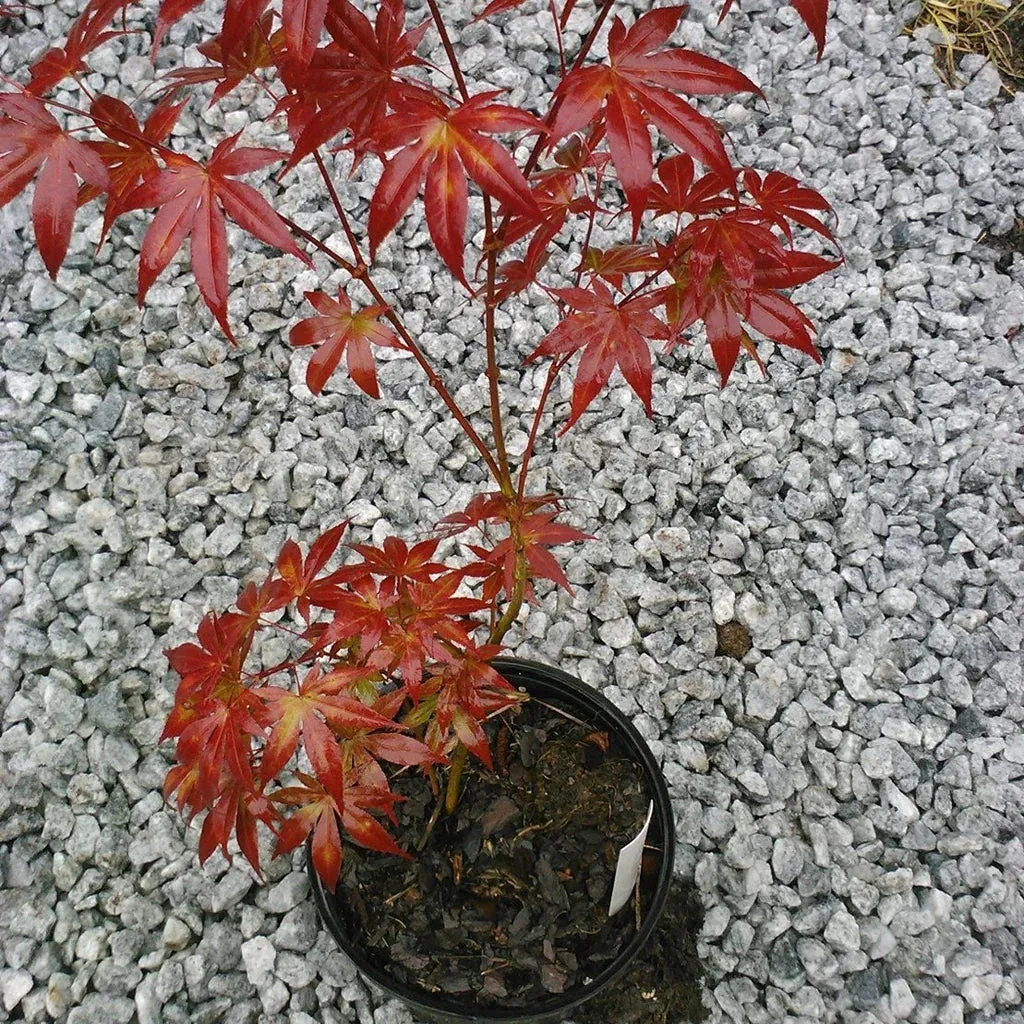
The leaf is palmate, with the lobes spreading from one point like fingers on a hand. It is a 2 to 4 inch leaf with 5 lobes plus 2 small lobes near the base.
Here is how the counts line up across sources, including the species for comparison.
| Source | Lobes |
|---|---|
| Bloodgood | 5, plus 2 small basal lobes |
| Species | 5–9, most deeply lobed |
The species runs up to nine lobes and leaves of 2 to 5 inches, so a leaf with eight or nine lobes is a hint that the tree is not a Bloodgood. The leaves also sit in pairs facing each other on the twig, which is the opposite arrangement. Maples with alternate leaves are not Japanese maples.
Edge, Vein and Color
The lobe edges are finely toothed, and the veins fan out from the base of the blade into each lobe. Run a finger along one lobe and you feel the teeth. The color holds through summer, and the fall color follows later, as our fall color guide explains.
In hot, dry areas the leaves may turn greenish red. That is a site effect, not a different tree, and our guide on why a Bloodgood turns green explains what to change. We grow our Bloodgoods in our own rows, so the lobe shape and twig color are visible on the plant before you buy.
Three Checks That Confirm a Bloodgood Japanese Maple
Put the details together and you can run the identification in a minute on any tree. Run these in order, and stop when one fails.
- Count the lobes. Pick a mature leaf from mid-crown. It should be 2 to 4 inches long, with five slender-pointed lobes and two small ones near the base. A leaf with eight or nine lobes points to the species or another cultivar.
- Match the leaf and the twig. A true Bloodgood has burgundy leaves and thin, reddish current-year stems. A burgundy leaf on a green twig is a flag. A greenish-red leaf in a hot, dry spot is not, because the site explains it.
- Read the crown and the trunk. Look for several gray-brown stems and a rounded, broad crown on an older tree, or an upright vase on a young one. Weeping or mounding forms are a different plant. If you are weighing it against a laceleaf, our Bloodgood and Crimson Queen comparison covers the difference in form.
No single check is proof. Two out of three with the third unclear is usually still a Bloodgood. Zero or one is not. When the checks disagree, look at the tree again in another season, because winter shows the twigs and trunk and summer shows the leaf.
Recognizing a Bloodgood Japanese Maple at Twenty Feet
A Bloodgood is a 12 to 20 foot tree, about as wide as it is tall, with a crown that opens from a vase into a broad dome. The bark is gray and wrinkled on several stems, the new twigs are red, and the seeds hang in pairs with wings. The leaf does the final work.
Bloodgood Japanese Maple
Nursery-grown Bloodgood Japanese Maple in sizes from QT Container, shipped to your door.
From $49.49
Shop Now →Five to seven lobes. Burgundy leaf. Red twig. Gray-brown trunk. Stop. On our farms we grow Bloodgood in moist, well-drained soil with shelter from drying wind and some afternoon shade, because those are the conditions that keep its color deep. We are growers with our own farms, and we grow and sell top-quality trees.